How to Get Your Pancreas Working Again
Norwegian version of this folio
Body can regain the ability to produce insulin
Researchers have discovered that patients with type 1 diabetes can regain the power to produce insulin. They showed that insulin-producing cells can recover exterior the body.
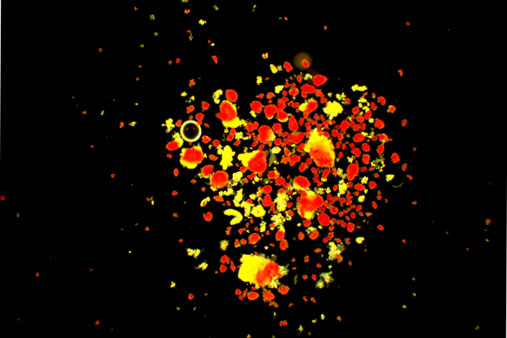
Hand-picked beta cells from the islets of Langerhans in the pancreas. Photo: Oskar Skog, Uppsala University.
Type i diabetes is a serious illness that affects many children and adolescents. The disease causes the pancreas to finish producing insulin, a hormone that regulates blood sugar levels.
When blood sugar levels are too loftier, the smallest blood vessels in the torso eventually go damaged. This can lead to serious health problems further down the line, including centre attacks, stroke, blindness, kidney failure and foot amputations.
Professor Knut Dahl-Jørgensen and doctoral student Lars Krogvold are leading a research project, (DiViD), in which they want to ascertain among other things whether a virus in the pancreas might cause blazon 1 diabetes.
They accept previously discovered viruses in hormone-producing cells, the so-chosen islets of Langerhans, in the pancreas. Now their inquiry has generated some new and surprising results.
 Lars Krogvold, doctoral educatee at the Academy of Oslo and paediatrician at Oslo University Hospital. Photograph: Individual
Recover the ability to produce insulin
Lars Krogvold explains:
"We found that the insulin-producing cells still have the ability to produce insulin when they are stimulated in the lab.
But what's new is our boosted discovery that the cells increased their ability to produce insulin afterwards a few days outside the body.
Indeed, some became roughly as good at making insulin equally cells from people without diabetes.
Some of the hormone-producing cells in the pancreas, the beta cells, produce insulin when they are stimulated by sugar.
Previous work has shown that y'all do not immediately lose your ability to produce insulin when yous are first diagnosed with type 1 diabetes".
Can improve patients' daily lives
"Our findings might mean that insulin production can be partially restored if we can find a fashion of stopping the disease procedure. The potential for insulin product is greater than previously thought. The take chances of developing health bug later on on is lower for those who manage to maintain a certain level of insulin production. Less supplementary insulin means that yous will be better off every bit a patient", says Krogvold.
Stimulated by sugar
The aim of the study was to determine whether beta cells nevertheless have the ability to produce insulin after the patient has been diagnosed.The researchers bathed the cells in a solution through which sugar was passed. They then measured the insulin content of this solution.
"The really exciting affair here is that insulin production increases when the cells are removed from the body and placed in an environment that is not diabetes-inducing. That your cells produce a little insulin the twenty-four hour period after you have been diagnosed with diabetes is not unusual. What surprised us was that the cells increased their ability to produce insulin over time and that afterwards a few days the level was budgeted normal", says Krogvold.
RNA sequencing
In the study the researchers collected tissue samples from the pancreases of living patients presently subsequently they had been diagnosed.
A technique chosen RNA sequencing was performed on cells from half dozen living and ii deceased donors. Sequencing is a style of mapping genes. The results were compared with cells from three healthy donors.
"A complete set of Deoxyribonucleic acid is nowadays inside all cells. Dna consists of a long series of genes, and those genes that the jail cell needs to apply in a given process are read off to form an opposite strand called RNA. RNA can act as a recipe for proteins".
This is a complicated process. When the cell realises that it needs to make a protein, structures called ribosomes read off the RNA. All of the necessary amino acids are then assembled to brand a new protein, post-obit the recipe contained within the RNA. Ribosomes are a complex of molecules and proteins that are found inside all prison cell types, and it is here that protein assembly occurs.
"RNA for all the genes involved in insulin production was establish in the tissue samples. We interpret this equally pregnant that the cellular machinery for producing insulin is all the same intact. This was confirmed when we saw that the beta cells produced insulin", concludes Krogvold.
The tissue samples were sent to Uppsala University Hospital, where the analyses were performed.
Knut Dahl-Jørgensen is a professor at the Kinesthesia of Medicine, University of Oslo and head of the Oslo Diabetes Research Centre. Lars Krogvold is a doctoral student at the University of Oslo and a paediatrician at Oslo University Hospital.
Published Mar. 23, 2015 1:17 PM - Final modified Mar. 26, 2019 2:38 PM
lapointeclach1965.blogspot.com
Source: https://www.med.uio.no/klinmed/english/research/news-and-events/news/2015/regain-ability-insulin.html
0 Response to "How to Get Your Pancreas Working Again"
Postar um comentário